
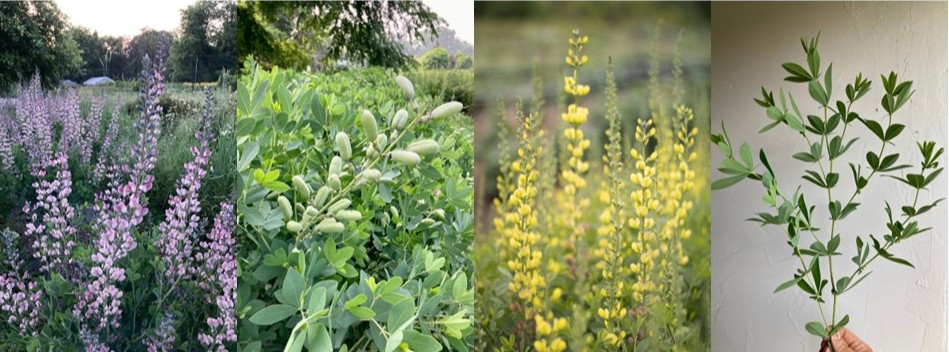
If you love the wild, meadowy look that’s trending in wedding work and daily designs but wish delphinium would last a touch longer, meet baptisia. Sometimes called false indigo, this native perennial delivers graceful spires, nuanced colors, and surprising versatility—yet it remains under-used in the cut-flower world. Here’s why it deserves a prime spot on your recipe sheets this season.
Color & Function You Crave
- Palette Range: Classic Baptisia australis features that coveted blue-purple hue, but plant breeders have expanded the spectrum to smokey amethyst, buttery yellow, crisp lemon, near-white, hazy lavender, and muted pink. Each is exquisite.
- Bicolor Blooms: Many varieties of baptisia have multiple hues in their spikes with younger buds being more vibrantly colored and maturing florets going to smokey hues such as copper or brown. This evolution of the blooms adds a magical unfolding to your designs for customers to enjoy over several days. And baptisia is often a good “blender” in a design, marrying colors that might otherwise be jarring together.
- Elegant Architecture: Each 18- to 30-inch stem carries a slim taper of pea-shaped florets—think of a leaner lupine or a slender delphinium. As blooms fade, inflated sage green seedpods develop, offering ready-made textural accents for design work.
- Native Credibility: Baptisia supports pollinators and requires zero pesticides or supplemental watering once established— making for an easy sustainability talking point for eco-minded clients.

Season & Vase Life
- Seasonality: The bloom window for baptisia in our area is mid-May through early June. When peonies are in bloom, baptisia is in bloom. The fun doesn’t stop with just the blooms though. Soon after the flowers fade, dramatic seed pods form. And throughout summer, baptisia foliage is a must for all your vase designs. Baptisia is a true triple threat!
- Harvest Stage & Processing: PFG growers harvest baptisia flowers when about half of the florets on the spike are open. Cut any earlier and it won’t color-up fully and may droop. Because baptisia is so popular with pollinators, the blooms at the bottom of the spike have usually been pollinated already by the time of harvest. Pollinated blooms shatter quickly. This is to be expected when you receive baptisia from PFG. Don’t worry, your baptisia is still fresh and healthy! Simply strip off the old blooms at the base of the spike like you would strip foliage from any other stem during processing. Then the rest of the spike will open up and last beautifully in the vase.
- Storage: Baptisia is best held at 34–38 °F. Another bonus to baptisia is that it is not nearly as ethylene sensitive as most spike blooms so it holds for quite a long time in the cooler, up to 10 days.
- Vase Life: Once in a design at room temp, the flowers and foliage last 7–10 days. Seed pods last much longer and can even be dried.
Bottom Line
Baptisia offers a durable, native, and visually striking stem that bridges the gap between spring bulbs and high-summer showstoppers. Thanks to the seed pods and foliage, it’s also a real workhorse throughout summer! Add a few bunches to your next order, and you’ll wonder how your cooler ever felt complete without those dreamy spires.